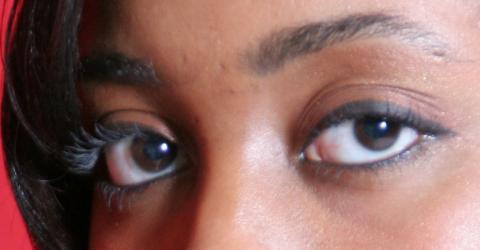
Shades of Understanding: Denying My Roots By Relaxing Them?

I wish there was a video for this version but alas, just the song.

India.Arie “I Am Not My Hair” featuring P!nk (Please note they both punctuation in their names. Haha)

I recently had the pleasure of having dinner and with two British gentlemen during a conference.  While the conversation covered a number of topics, we spent quite a bit of time on race relations and related issues.  I foresee any number of future posts inspired by this conversation.  One comment in particular made me think about my overall experience with my hair.

One of the guys (of Asian descent, while that distinction is not necessary, I believe it helps add a little color to the story, no pun intended) asked me innocently but pointedly if my hair looks like that in the morning.  At first, it took me a moment to grasp his meaning.  Of course, I’ll need to comb it but for the most part, unless sweat or water are a factor, I don’t have to do all that much to my hair.  Only having to wash it once a week, I generally just get up and go.

Of course, he didn’t necessarily mean the “morning” so much as was my hair naturally straight.  completely unashamed, I shook my head no and explained that it was chemically straightened and that my roots have to be processed every 2 months.  When asked why I did this to myself, I explained that it’s been this way since age 12 and that “going natural” would require cutting it all off.  I’m not entirely confident I could pull off the little boy look.  The other gentleman spoke of a woman he’d dated from the West Indies (I believe) who’d decided to “go natural” and how he’d quite liked it.  This comment is also important but I’ll get into that later.  The most important thing to take from their comments was that while they accepted it, neither understood the need/desire to permanently breakdown the chemical bonds of my hair.

So why do I relax my hair?  (You’ll commonly hear black women refer to perming their hair.  Our perms are actually relaxers.  They straighten, not curl.  The processes do different things.  A perm creates temporary bonds.  That’s why the loosen up over time.  A relaxer on the other hand breaks down bonds.  There’s no coming back from that.  It’s permanent until you cut the treated hair off.)  There’s no need to really dig into the history.  In the early 1900s, both commercial relaxers and hot combs (the precursor to the Chi) were unleashed upon the general public.  Needless to say, black women around the world have been straightening their hair for 100 years.  Walk through any African-American self-help section in a bookstore and you’ll no doubt find some book about the black woman ideal and our struggles with our hair.  History and magazines tell us we straighten our hair to emulate the Caucasian ideal.  But I’m not also bleaching my skin, my hair will never make it past my shoulders, and I’m obviously not going to be able to pass for white, so why do I relax my hair?

There’s no simple answer to that question.  The closest I can get is fear.  I’ve never known my hair to be any other way.  Sure, throughout my childhood, my hair was “natural” but it was still straightened.  The hot comb usually came out on Saturday so you’re hair would still be presentable on Sunday for church.  I’ve always strived for long, straight, full, beautiful hair.  As I came to accept my hair would never look like Tatiyana Ali (Fresh Prince reference for you) or Naomi Campbell’s, I decided to do the best I could with what I had.  For 13 years, as funds and availability allowed, I’ve paid someone to burn the hell out of my scalp to straighten the “new growth” aka my roots.

In college, I remember getting into a debate with an African-American male administrator at a conference funny enough about race and ethnicity.  While in a group circle to discuss the sessions of the day, he launched into a tirade about black women relaxing their hair.  With his age (50s-ish) and “participation” in the Civil Rights Movement, he felt completely justified in lecturing us.  (I’ll have to say that I believe he just saw a collection of early 20s black women as easy targets to vent.  His wife had bone-straight, chemically-altered hair.)  Although a few of the women in the room had natural hair, the general consensus among us all was that to relax or not to relax was a personal choice, usually driven by taste and convenience.  The same reasons I could use to explainrelaxing my hair, another women could use to justify going natural.  And you know what?  More power to us both.

The struggles I remember with my hair during childhood are not necessarily what I’d endure now.  For the most part, the issues arose because someone was trying to keep my hair straight and “manageable.”  Rain, sweat, swimming, basically anything involving moisture turned 30 minutes worth of straightening into a dual-textured, frizzy mess.  I’m not sure I’d experience the same battles now.  If I were go natural, my hair (texture-willing) would be worn in such a way that water would not by my enemy.  What a novel concept!  (Washing my hair once a week really limits my water-based activities.  Sure, I could wash it more often but I’m not really willing to go through the 1 1/2 hr washing-drying-straightening-curling process more often.  Some people find the once-a-week thing gross.  Please understand that my hair does not get oily or greasy.  I actually have to put the moisture into my hair.  Washing it everyday would require buckets of leave in conditioner or cause it to get brittle and break off.  Trust me.  Once a week is the way to go for me.)

I’ve recently begun to contemplate just being bold and cutting it all off, starting over.  Aside from the initial shock, I’m trying to imagine how bad it could be.  Aside from the extreme possibility of resembling a little boy for several years, I’m at a loss for “good reasons” not to do it.   Well, of course there’s always the possibility that I’ll absolutely hate it.  Slow hair growth makes this decision especially difficult.

If I ever choose to take the plunge and rediscover my hair unaltered, it will be for no reasons other than vanity and ease.  I would love to not hide from the rain, go swimming at will and not have to burn my ears accidentally or scalp intentionally every 8 weeks.  But I also like running my fingers through my straight, although short, hair and blending in.  Natural hair seems to make a personal and/or political statement I don’t really care to make.  Me going natural would not necessarily mean I’m trying ot be “more black” or embracing my cultural roots by growing out my physical ones.  For good or bad, my roots are just a part of me that showcases my melting pot heritage.  Relaxers or afros, they all seem to define or explain everything and nothing about me.

Wishing my hair would grow faster so this decision wouldn’t seem so monumental,

Jo’van

Shades of Understanding: Being “Just Black”

“The African-American experience” has been a hot topic in the media for the last year.  With Barack Obama running for president (and incidentally being elected), black hope, deliverance, equality has been all over the print, TV, radio and online media.  Some feel a black President signals the day African-Americans have become fully equal.  Others consider it to be a stepping stone but not the finale.  Either way, being Black has been discussed but not really examined.

What does it mean to be black/African-American?  It’s really a personal definition.  There are some common traits/histories that the group shares but YOUR experiences are the most important definers.  Rather than speak for a rather large group, I’ll just try to explain my feelings about it.

For most people that I know (that aren’t black), being “something”, whatever it is, is defined by a history, what your particular group has “gone through.”  While you may be American, you’re also Greek, Spanish, German, Italian, Panamanian, Indian, Canadian, Nigerian, Irish, Brazilian, etc.  Just being able to claim a country and culture outside of the U.S. seems to empower people to be something extra, justifying failed attempts to learn a second language, perfecting one “authentic” dish or a trip you can’t afford to the land of your forefathers.  I’ve realized that over the years, I’ve grown almost bitter about this lack of extended identity.  Yes, African-American culture is rich and thick.  But it’s short.  What’s 300 years in the grand scheme of things?

Let’s say a generation is 25 years long.  300 years is roughly 12 generations.  Growing up, I was blessed to spend time with great-grandmothers, grandmothers and my parents.  We represented 4 generations, a third of African-American history.  That kind of realization helps put the reasons I feel the way I do into perspective.

The roots of “my people” were ripped up and displaced.  Sure, I could “go back to Africa” to visit the land of my forefathers but the continent’s just a little big and somewhat diverse.  True, most slaves brought to the Americas were from West Africa but that only narrows it down to a minimum of 5 currently sovereign nations.  That’s like saying I could be German, Swedish, Turkish, Italian or Austrian.  Just a little different, right?

Like my family, the vast majority of African-Americans have family members of different, usually European, connections.  The only part of my family that I can trace back more than 5 generations is Irish.  There’s nothing wrong with that.  It’s kind of cool.  But for some reason, I don’t feel a strong connection to Dublin, U2 or redheads.  I giggle when I say it out loud, especially around St. Patrick’s Day.  I’m African-American.  Our family also has Cherokee roots.  Unfortunately, I know very little about Cherokee history or culture.  It feels almost wrong to claim it.  Everyone from the South, seems to have a Cherokee great-grandmother somewhere in their family tree.  So I go back to being just black.  What is that?

In college, I had several conversations with African immigrant students about identification while in the US.  Their ethnicities covered every major region of the continent, different languages, religions, cultures, histories.  But one thing most of the students I spoke with agreed on was the fact that they didn’t want to be considered black or African-American while in the States.  At first, I thought it was because they’d like to be identified with/by their home country.  And while that’s true, several people explained to me that it was equally important for them not to be tied to the sordid, unfavorable image of African-Americans here.  How could people who ARE the African part of my African-American identity be SO against being what I am?  What’s wrong with it?  Unfortunately, many of the stereotypes we peddle here are bought around the world.  But there’s enough to say about that for a separate post.  Suffice it to say, I was surprised, hurt and later educated about how we’re seen by our theoretical brothers and sisters and fully get where they may be coming from.

There’s nothing I can do about having a limited history.  And I’m not ashamed of any aspect of the history I can claim now.  It’s just that I sometimes wish I had more I could claim, hope to embrace, love enough to teach.  African-American history is completely American history.  While parts are often (intentionally or not) left out of our traditional K-12 history books, African-American history is nothing but American history.  There is no and never was an Africa-America.  Our history is just red (blood, sweat and tears), white (captors to coworkers) and blue(s).  Every now and again, I kinda wish “we” could share the same kind of specialness other cultures do, being able to claim (if only partially) somewhere/something else.  Not complaints, just thoughts.

Singing “Follow the Drinking Gourd”,

Jo’van

The World…As I See It: Why I Should Really Celebrate Cinco de Mayo

A repost from last year but it still works. 🙂

Yes, I just love this song and Carlos Santana’s Mexican so it works, right?  Haha.

Cinco de Mayo!!!  For many people, May 5th has something to do with a Mexican battle and is a perfect excuse to gorge on chips and salsa, inhale soft shell tacos and drink a lot of (if not too many) Corona’s and Mexican Martinis.  Traditionally for me, Cinco de Mayo celebrations are about finding the most colorful dress you have and preparing to drink to oblivion (or most often in my case watching other people drink to oblivion).  There’s been very little history or real knowledge associated with the date.  But today I learned something new about the holiday.  Who knew Cinco de Mayo had a (near) direct relationship to the emancipation of slavery?

I learned this through a post titled “Market Research: Cinco de Mayo Isn’t Indepence Day” on Advertising Age’s The Big Tent blog.  According to the Fayetville Observer (North Carolina):

“During this time, Confederate General Robert E. Lee was enjoying success, and had the French defeated México at Puebla, France would have aided the South in the American Civil War in order to free Southern ports of the Union Blockade. The Mexicans had won a great victory that kept Napoleon III from supplying the confederate rebels for another year, allowing the United States to build the greatest army the world had ever seen.”

While there’s a lot more to it, the success of the Mexicans over the French aided in the Yankees over the Confederates.  Viva la Mexico!

Toasting her Corona,

Jo’van

  • December 2025
    S M T W T F S
     123456
    78910111213
    14151617181920
    21222324252627
    28293031  
  • Archives

  • Follow The Truth: According to Jo'van on WordPress.com
  • Enter your email address to follow Jo'van and receive her updates.